SASI
Sub-Action Semantics Integrated cross-modal fusion for robust early action recognition

TL;DR: SASI uses sub-action semantics to help a skeleton-based model recognize human actions earlier from incomplete observations.
Abstract
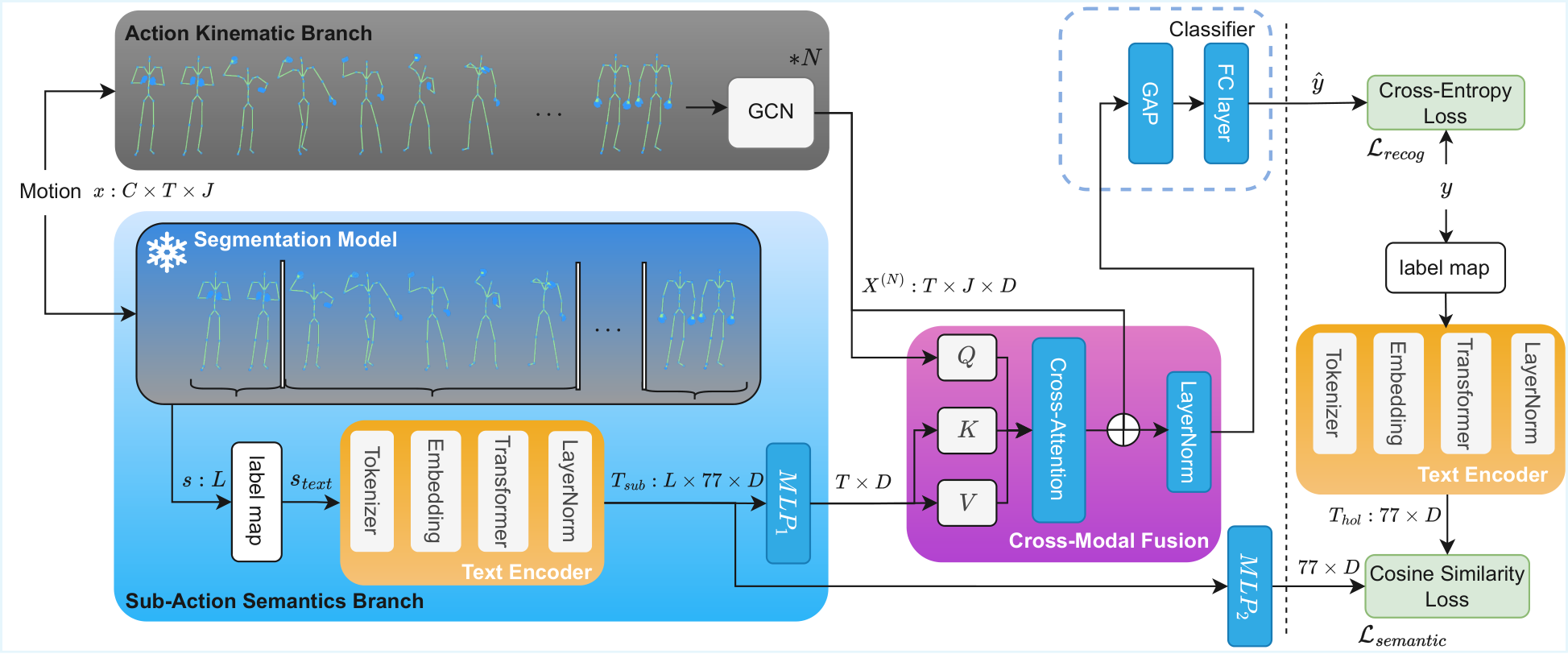
Human actions are naturally composed of smaller, meaningful sub-actions. SASI integrates those semantics with skeleton-based spatiotemporal features through a dual-branch, cross-modal fusion framework. The method is designed for robust early action recognition in human–robot interaction and runs in real time at 29 Hz. Experiments on BABEL show improved recognition from both complete and partial action sequences.
Method
Kinematic branch
A GCN backbone extracts spatial and temporal features from the skeleton sequence.
Semantic branch
Predicted sub-actions are represented as language features, exploring fine-grained semantic relationship in motion.
Cross-modal fusion
Cross-attention aligns kinematic features with sub-action semantics to recognize actions from partial observations.
Results

Video
Citation
@misc{cao2026sasi,
  title         = {SASI: Leveraging Sub-Action Semantics for Robust Early Action Recognition in Human-Robot Interaction},
  author        = {Yongpeng Cao and Masahiro Hirano and Hyuno Kim and Yuji Yamakawa},
  year          = {2026},
  eprint        = {2604.27508},
  archivePrefix = {arXiv},
  primaryClass  = {cs.RO}
}
We used AI tools to create this page.
References
2026
-
 SASI: Leveraging Sub-Action Semantics for Robust Early Action Recognition in Human-Robot InteractionApr 2026